

Is HRT Safe?
For most healthy women under the age of 60, or within ten years of menopause, current evidence shows that the benefits of modern Menopause Hormone Therapy (MHT) generally outweigh the risks. Modern HRT uses different formulations and prescribing approaches than those commonly studied twenty years ago, with treatment tailored to each woman’s individual needs and health profile.
Why the HRT Story Matters More Than Ever
If you mention HRT in a room full of women, you’ll often hear very different reactions.
Some women will tell you it transformed their lives.
Others will tell you they were warned never to take it.
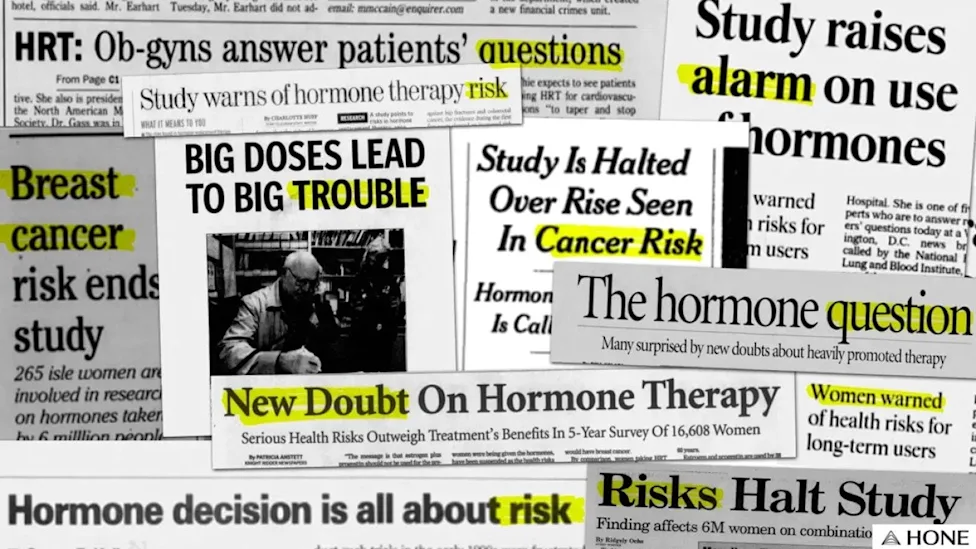
Many still remember the alarming newspaper headlines from the early 2000s linking hormone replacement therapy to breast cancer, heart disease and stroke.
Even today, more than twenty years later, those headlines continue to influence conversations about menopause.
Yet the reality is far more complex.
The story of Hormone Replacement Therapy (HRT), increasingly known as Menopause Hormone Therapy (MHT), is one of scientific discovery, medical advancement, media influence and ultimately a return to evidence-based care.
Understanding that journey helps explain why modern menopause care looks very different today.
Women are now spending around one-third of their lives after menopause. As life expectancy increases and awareness grows, more women are seeking evidence-based information about their options.
The questions they ask are remarkably consistent:
- Is HRT safe?
- What are body-identical hormones?
- What happened in the Women’s Health Initiative study?
- Why did doctors stop prescribing HRT?
- Why are menopause specialists recommending it again?
To answer those questions, we need to start at the beginning.
The Origins of Hormone Therapy
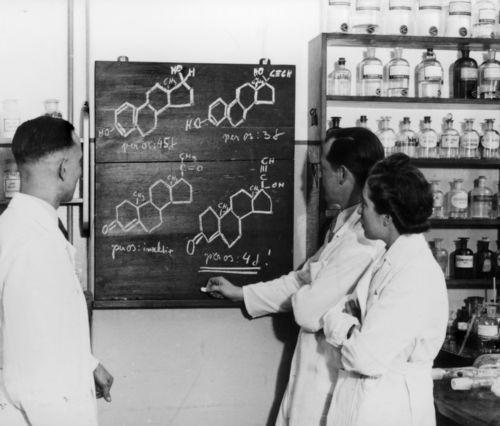
The concept of replacing hormones is more than a century old. Scientists first began identifying ovarian hormones in the late nineteenth and early twentieth centuries. By the 1920s and 1930s, researchers had started experimenting with ways of extracting and producing oestrogen.
These early preparations were far from perfect. Some were derived from animal ovarian tissue. Others were created synthetically in laboratories. Nevertheless, they represented the first serious attempts to address symptoms that many women had been told to simply endure.
At the time, menopause was rarely discussed openly. Women experiencing hot flushes, night sweats, anxiety, sleep disruption and mood changes often received little support or understanding.
The discovery of hormone therapy changed that. For the first time, there appeared to be a treatment capable of addressing the symptoms associated with menopause.
The Rise of HRT and the Promise of Better Menopause Care
The 1940s and 1950s saw the development of commercially available hormone therapies. One of the most widely prescribed was Premarin®, a medication derived from conjugated equine oestrogens.
The name Premarin comes from:
PREgnant MARes urINe
At the time, Premarin represented a significant breakthrough. Women who had struggled with debilitating menopausal symptoms often reported dramatic improvements.
As life expectancy increased, doctors began recognising that menopause was not simply a short transition but a major life stage that could affect health and wellbeing for decades.
Interest in hormone therapy expanded rapidly during the 1960s and 1970s.
A pivotal moment came in 1966 when American physician Dr Robert Wilson published Feminine Forever, a book that promoted the concept of treating menopause as a hormone deficiency.
Although some of its claims would later be criticised, the book helped bring menopause into mainstream discussion. Millions of women began receiving hormone therapy.
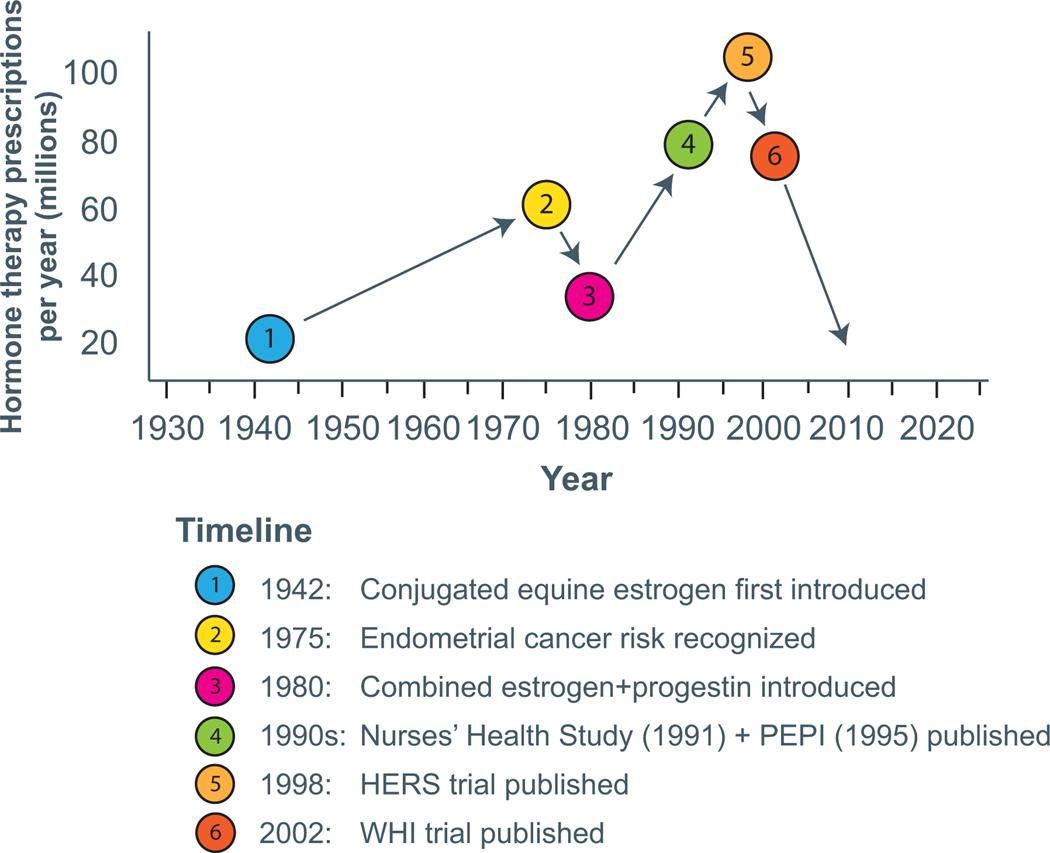
The development of HRT has been shaped by evolving scientific understanding, safety research and large clinical studies. Landmark events include the introduction of conjugated equine oestrogen (1942), recognition of endometrial cancer risk associated with unopposed oestrogen (1975), introduction of combined oestrogen-progestogen therapy (1980), publication of influential observational and clinical studies during the 1990s, and the Women’s Health Initiative (WHI) study in 2002. These milestones underpin the transition from early hormone therapies to today’s body-identical, individualised Menopause Hormone Therapy (MHT).Alt text: Timeline graph showing the history of Hormone Replacement Therapy (HRT) from 1942 to 2002, including the introduction of conjugated equine oestrogen, recognition of endometrial cancer risk, development of combined oestrogen and progesterone therapy, publication of the Nurses’ Health Study, HERS trial and Women’s Health Initiative (WHI) study, illustrating changes in HRT prescribing over time.
An Important Discovery: The Role of Progesterone
As HRT use increased, researchers identified an important concern. Women taking oestrogen alone who still had a uterus faced an increased risk of endometrial cancer.
Scientists soon understood why. Oestrogen stimulates the lining of the womb. Without progesterone to balance that effect, abnormal growth can occur. This discovery led to one of the most important advances in menopause medicine:
The addition of progesterone alongside oestrogen. Today, this remains standard practice for most women who have not undergone hysterectomy.
The Growth of HRT During the 1980s and 1990s
By the 1980s and 1990s, HRT had become widely accepted.
Research suggested benefits including:
- Relief from menopausal symptoms
- Improved sleep
- Better quality of life
- Reduced risk of osteoporosis
- Improved bone health
Many clinicians believed HRT could potentially support long-term health as well as symptom management. Prescriptions continued to rise worldwide. Then everything changed.
The Women’s Health Initiative (WHI) Era
The Study That Changed Everything
In 2002, results from the Women’s Health Initiative (WHI) study were published.
The headlines were immediate and dramatic.
Many women saw reports claiming:
- HRT causes breast cancer
- HRT causes heart disease
- HRT is dangerous
Almost overnight, prescriptions fell dramatically. Women stopped treatment. Doctors became more cautious. Fear replaced confidence. Even today, the impact of those headlines remains visible in clinics across the world.
What the Headlines Missed
The WHI study was not fraudulent. Nor was it meaningless. However, the way the results were communicated to the public lacked important context. Several critical details were often overlooked.
The Average Participant Was 63
Most women in the study were not newly menopausal. Many were more than ten years beyond menopause. Today we understand that timing matters. Starting hormone therapy shortly after menopause appears very different from starting it much later.
Many Women Had Existing Risk Factors
A significant proportion of participants had:
- Obesity
- Hypertension
- Smoking history
- Cardiovascular disease
These factors influence health outcomes independently of hormone therapy.
Older Hormones Were Used
The study largely evaluated:
- Conjugated Equine Oestrogens (CEE)
- Medroxyprogesterone Acetate (MPA)
These are not the same as many modern therapies prescribed today.
Relative Risk Was Often Misunderstood
Media reports frequently highlighted relative risk increases rather than absolute risk. This made risks appear much larger than they actually were. The distinction was rarely explained clearly to the public.
What Happened Next?
Over the following two decades, researchers revisited the data. The findings became clearer.
For many healthy women:
- Benefits often outweigh risks
- Symptom improvement can be substantial
- Quality of life often improves significantly
The menopause community began rebuilding confidence through evidence-based education.
From Premarin to Body-Identical Hormones
One of the most important developments in menopause medicine has been the evolution of hormone formulations.
Modern HRT increasingly uses:
Body-Identical Oestradiol
Available as:
- Patches
- Gels
- Sprays
These contain oestradiol that is chemically identical to the hormone naturally produced by the ovaries.
Micronised Progesterone
Micronised progesterone is derived from plant sources and processed into a form that closely resembles natural human progesterone. Many menopause specialists consider it to have a favourable side-effect profile compared with older synthetic progestogens.
Why Transdermal Oestrogen Changed Menopause Care
Historically, most HRT was prescribed as tablets.
Today, many women use:
- Patches
- Gels
- Sprays
This allows oestrogen to enter the bloodstream directly.
Potential advantages include:
- Avoiding first-pass metabolism through the liver
- Consistent hormone delivery
- Flexible dosing options
- Avoidance of VTE (Venous Thromboembolism) risk with transdermal HRT
This is one reason modern HRT should not simply be compared with older therapies.

What Do Current Menopause Guidelines Actually Say?
One of the biggest misconceptions about HRT is that experts remain divided. In reality, major menopause organisations are remarkably aligned.
NICE
NICE recognises HRT as the most effective treatment for:
- Hot flushes
- Night sweats
NICE also acknowledges benefits for bone health and quality of life.
British Menopause Society (BMS)
The BMS supports:
- Individualised care
- Shared decision-making
- Appropriate risk assessment
- Evidence-based prescribing
International Menopause Society (IMS)
The IMS states that for many healthy women under 60 and within ten years of menopause, the benefits of hormone therapy outweigh the risks.
The Menopause Society (formerly NAMS)
This organisation similarly supports hormone therapy for appropriate women experiencing menopausal symptoms.
The consensus is clear:
Menopause care should be personalised.
Specialists Helping Shape Modern Menopause Care
Modern menopause medicine has been influenced by leading researchers and clinicians including:
- Professor Nick Panay
- Professor Susan Davis
- Professor Vikram Talaulikar
- Dr Heather Currie
- Dr Paula Briggs
- Dr Jennifer Gunter
Within The Menopause Consortium, specialist care and education is led by:
- Dr Joanne Hobson
- Dr Natasha Davidson
- Dr Wendy Knoops
- Dr Sarah Wright
- Dr Sarah Hastings
- Dr Paula Bradley
- Dr Saadat Ahsan
- Dr Chris De Kauwe
- Mr Amr Moneib
These clinicians continue to support evidence-based women’s healthcare, education and menopause awareness.
Is HRT Safe Today?
This remains the most searched menopause question online. The answer is nuanced. No treatment is entirely without risk.
However, for most healthy women under 60, or within ten years of menopause, current evidence shows that the benefits of modern menopause hormone therapy generally outweigh the risks.
The decision should always be made following personalised assessment and discussion with an appropriately qualified healthcare professional.
The Future of Menopause Care
The future is increasingly personalised.
Emerging areas include:
- Precision medicine
- Genetic risk assessment
- Better cardiovascular risk profiling
- Expanded testosterone research
- Improved understanding of brain health
As menopause awareness grows, women are increasingly empowered to make informed decisions based on evidence rather than fear.
Conclusion
Perhaps the greatest misconception about HRT is that the story ended in 2002.
It didn’t. In many ways, that was simply the beginning of a new chapter. Twenty years of additional research have transformed our understanding of menopause, hormones and women’s long-term health.
Modern menopause care is more personalised, more evidence-based and more patient-centred than ever before. For many women, Menopause Hormone Therapy remains the most effective treatment available for managing symptoms and improving quality of life.
Internal links to add:
- Menopause Consultations
- Testosterone Clinics
- Women’s Health Specialists
- Menopause Academy
- Book an Appointment
References
This article reflects current guidance and evidence from:
- National Institute for Health and Care Excellence (NICE)
- British Menopause Society (BMS)
- International Menopause Society (IMS)
- The Menopause Society
- Published work from Professor Nick Panay, Professor Susan Davis, Professor Vikram Talaulikar, Dr Heather Currie and other recognised menopause specialists.
